
Germaine De Peralta
I must confess: during my travels to Banaue, Philippines, I became a rogue rice prospector.
I went on a high-stakes hunt for a rare, ancient heirloom grain called Tinawon rice, determined to bring it home to Canada.
It started with a whisper in the market. An elderly vendor convinced me to buy her final bags. I rushed them to my favourite local haunt, 7th Heaven Café, and begged the kitchen staff to cook this kind of rice. They said they didn’t have any; it was hard to find.
That’s when I knew I was holding on to something mythical.
When they served it, my jaw dropped. Just two uncooked cups had exploded into a feast that fed six people. The grains were massive, plump, juicy, and bursting with a rich, nutty depth.
As we ate longganisa and drank ice-cold beer, a bunch of us sat around shooting the breeze, trading eerie Banaue ghost stories. We looked right out over Mount Paltog—the legendary mountain where murderers were buried. I was hooked.
The next day, the real hunt was on.
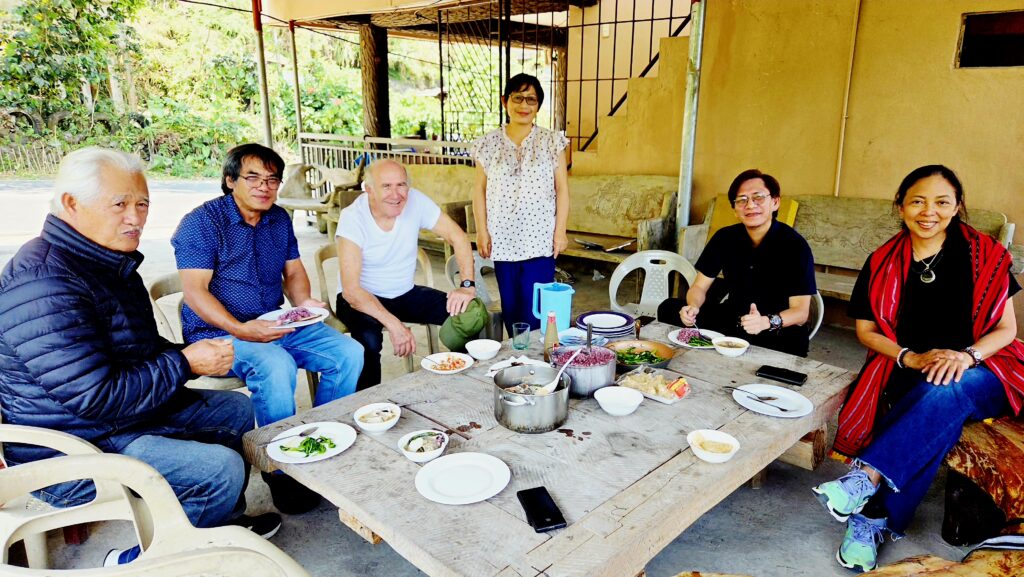
I tracked down a remote mountain farmers’ cooperative and crashed a meeting with local leaders and growers—Jimmy, Marivic, Anna, Raymund, and a fellow Canadian adventurer named Grant Lee.
Stacked on a large shelf were rows of one-kilogram bags of Tinawon rice—brown, black, red, purple, glutinous, and non-glutinous. I was thrilled!
They hardly knew me, yet they invited me to lunch. We crowded around a weathered outdoor wooden table, feasting on organic food and drinking what seemed like an endless supply of fiery native rice wine.
Before long, one of the guys and I were in a heated debate over which mumbaki, or local shaman, was more powerful, our hands slamming on the table as we jostled each other.
Out of nowhere, Grant Lee looked at me curiously. “There is a reason you were meant to come to Banaue,” he said.
What did he know that I didn’t? Was he channeling a mountain spirit—or was it simply the spirit of the wine talking? I honestly still don’t know.
I spent the day absorbing ancient farming secrets and getting beautifully tipsy with my new friends in Banaue. The conversation snaked from one topic to the next, taking a few irreverent turns here and there as the afternoon slipped by.
I left Banaue with my big catch: Ten pristine one-kilogram bags of Tinawon rice, packed tightly in my luggage.
Then the universe struck back.
A raging tropical storm forced a chaotic two-night layover in Tokyo.
When I returned to the airport for my flight to Ottawa, my suitcase was overweight. After hauling it through the airport to my hotel, and then back two days later, I was told to give up half my precious rice bags to lighten the load.
And if that weren’t enough, several bags had ruptured in my luggage. I spent my layover furiously picking rare purple and red grains out of my socks.
I finally landed in Ottawa with five precious kilograms of Tinawon rice left. I carefully lined the bags up in my pantry alongside the rest of my Banaue haul: bags of Sagada Brew and Barako Coffee. My sacred stash.
But I didn’t know the final betrayal would be waiting at home. A week later, two bags vanished. My roommate had surreptitiously snatched them to impress her friends after catching wind of how rare they were. I was furious.
Today, I’m left with just three precious one-kilogram bags of brown, red, and purple Tinawon rice, rationing them like fine caviar.
But staring at those remaining grains, my frustration fades.
Something in my heart nudges me:
The spirit of the rice.
And it is singing.
I went to Banaue carrying the weight of city life. Somewhere between the mountains, the rice terraces, the people, and those long afternoons around the table, I began to feel alive again.
I didn’t know what I was looking for at the time.
I now know: Life.
It was still in me. It had never left. This rice wasn’t a souvenir—it was a living invitation calling me back.